
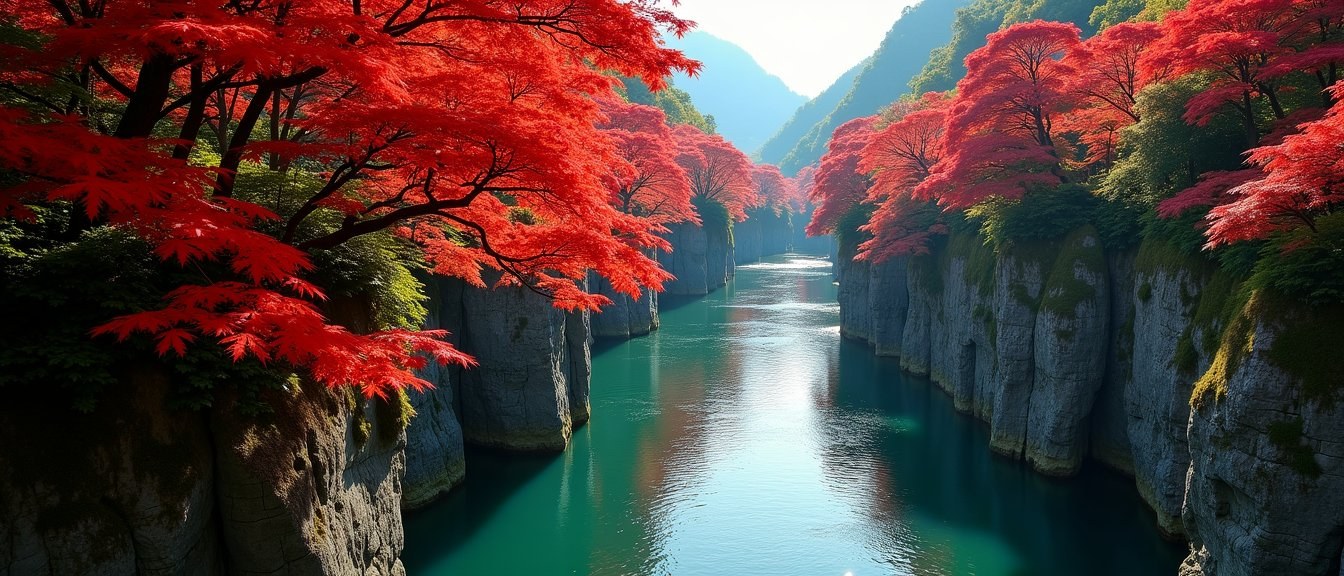
Kyushu autumn foliage runs long: the highlands turn from late October and the lowland maples hold into early December.
For 2026 that means highland color from about the last week of October, with Kumamoto, Saga and Fukuoka peaking late November into the first days of December. Peak dates shift by a week or two from year to year, so treat any fixed date as a starting point. Staying put in the city? The Fukuoka autumn leaves spots that work with kids are all reachable without a car.
You get crisp walking weather, red maples blazing across the highlands, and far fewer tourists than spring sakura season.
With kids it’s arguably the best season to go: cool weather for walking and thinner crowds at the headline sights.
Ryokan onsen are at their cozy peak too, perfect after a day outdoors in the mountains.
This guide lays out a 5-day route across three prefectures, chasing peak color as it moves down the mountains.
It runs from the Aso highlands through Yufuin and the Takachiho gorge down to Kumamoto.
It pairs with our prefecture-by-prefecture guides for hotels and food, so you can slow down wherever your family loves most.
If you only have a long weekend, our 3-day Fukuoka family itinerary covers the city-park half of this list instead.
When does Kyushu autumn foliage peak?

Foliage moves down the elevation: highlands turn first, lowlands later.
- Late October – mid November: Kuju mountains, Aso outer rim, Ebino plateau and Kurokawa onsen — the highest ground colors first
- Early – mid November: the Yufuin valley, with Lake Kinrin usually at its best around mid-month
- Mid – late November: Takachiho gorge
- Late November – early December: Kumamoto Castle, Saga gardens such as Mifuneyama Rakuen, Fukuoka city parks
- Plan-ahead: each window lasts roughly 10 days. The Japan Meteorological Agency records foliage dates but publishes no peak forecast — use the Japan Weather Association (tenki.jp) or Weathernews 1–2 weeks before you travel
Because that spread covers about six weeks, no single 5-day trip catches every stop at its best: go in early November for the highlands, Kurokawa and Yufuin, or mid-to-late November if Takachiho gorge and Kumamoto Castle matter most.
Dress for the elevation, not the forecast for Fukuoka city. Morning temperatures split sharply by altitude:
- Aso / Kuju (1,000m+): 3–8°C at dawn in late October — hats and gloves for kids
- Yufuin / Kurokawa (450–700m): 6–12°C mornings, 15–18°C by midday
- Kumamoto / Fukuoka lowlands: 10–18°C, a fleece layer is enough
Use the table below to match each stop with its peak window, a realistic kid-friendly visit length, and an easy lunch option nearby.
| Spot | Peak window | Kid-friendly visit | Nearby lunch |
|---|---|---|---|
| Aso highlands | Late Oct – early Nov | 2–3 hrs (stroller-tough) | Aso Station cafes |
| Yufuin valley | Early – mid Nov | 3–4 hrs (flat, easy) | Yunotsubo Yokocho stalls |
| Takachiho gorge | Mid – late Nov | 1.5–2 hrs + boat | Nagashi-somen shops |
| Kurokawa onsen | Late Oct – mid Nov | Overnight | Ryokan kaiseki dinner |
| Kumamoto Castle | Late Nov – early Dec | 2 hrs (flat paths) | Sakura-no-baba Josaien |
Best photo spots at each elevation
Where to stand, if you want one keeper shot per stop rather than fifty phone snaps:
- Aso: the Daikanbo lookout at sunrise — golden grassland against the caldera rim, best before 8:00
- Yufuin: Lake Kinrin’s north shore, where morning mist rises off the warm water under the maples
- Takachiho: from the rowboat looking back at Manai Falls, mid-morning when light drops into the gorge
- Kurokawa: the Marusuzu bridge over the Tanoharu river — note the Yuakari bamboo-lantern illumination is a winter event (20 December to the end of March), so autumn visitors get the bridge by daylight only
- Kumamoto: the long outer wall walk along the moat, framing red maples against the black castle walls, plus the big ginkgo in front of the keep in late November
Getting around: driving the autumn route
These five stops sit in rural highlands where trains and buses run infrequently, so a rental car is the practical choice for families.
Pick the car up at Fukuoka Airport or Hakata Station and drop it in Kumamoto to avoid backtracking; a one-way drop-off fee applies at the major chains, so budget for it.
Rough driving times between the overnight stops:
- Fukuoka (Hakata) → Aso: ~2.5 hrs via the Kyushu Expressway
- Aso → Yufuin: ~1.5 hrs along the scenic Yamanami Highway
- Yufuin → Kurokawa onsen: ~45 min by car (no direct train)
- Kurokawa → Takachiho: ~2 hrs through the mountains
- Takachiho → Kumamoto: ~2 hrs, then ~1.5 hrs on to Fukuoka
Book early for November weekends, and declare every child under six when you reserve: Japanese law requires a child seat for them, rental firms only carry a limited number, and they can refuse to hand over the car if you turn up without one.
Compare Fukuoka car rental rates on Klook →
 Not Driving? Private Driver around Kyushu
Not driving? A JR Kyushu rail pass covers the Hakata–Yufuin–Kumamoto legs, including Yufuin no Mori and the Kyushu Shinkansen, but you’ll need buses or taxis for Kurokawa and Takachiho.
It is sold only to non-Japanese passport holders living abroad and visiting on a temporary visitor visa, and you have to carry your passport whenever you use it — the 3-day Northern Kyushu version is ¥15,000 for adults, half price for ages 6–11.
5-Day Kyushu Autumn Family Itinerary

The route flows downhill with the color, so you chase peak foliage instead of missing it.
You start high at Aso, drop to Yufuin and Kurokawa, cross to Takachiho, and finish in Kumamoto.
Day 1–2: Aso highlands to Yufuin
Start in the Aso caldera while the 1,000m+ grasslands and Kuju maples are at their reddest.
Plan the Aso day around the outer rim and the grasslands, not the crater: after the January 2026 sightseeing-helicopter crash, the Aso Park toll road to the Nakadake crater is closed, the crater shuttle bus is suspended, and a 1km exclusion zone around the crater stays in force under volcanic alert level 2.
From there, drop into the Yufuin valley for its early-to-mid-November color and a first onsen night.
Yufuin’s ryokan cluster around Yunotsubo, a short walk from the station, so you can stroll to dinner after check-in.
Compare Yufuin ryokan deals on Agoda →
The scenic Yufuin no Mori sightseeing train runs Hakata to Yufuin in 2 hrs 14 min.
Every seat is reserved, and JR seats only go on sale one month before departure at 10:00 Japan time (JR Kyushu’s online advance application opens a week earlier), so set a reminder for that date rather than gambling on same-day tickets.
Reserve Yufuin no Mori tickets on Klook →
Day 3: Kurokawa onsen
Base in Kurokawa onsen for a riverside ryokan night.
Its 30 member ryokan share the ¥1,500 nyuto tegata pass (¥700 for children aged 3 to grade 6), good for three of the 25 open-air baths — one of the three stickers can be swapped for a snack or souvenir instead.
Bathing hours are 8:30–21:00, the pass stays valid six months, and it does not cover the private family baths, which each ryokan charges for separately.
Kurokawa ryokan quote per person for one night with dinner and breakfast rather than per room, so price the stay by head count.
Autumn weekends are the first dates to go, so book as soon as each ryokan’s reservation window opens.
Check Kurokawa ryokan availability on Agoda →
Day 4: Takachiho gorge
The Takachiho gorge is the trip’s visual highlight, framed by maples above the cliffs.
The rowboat costs ¥4,100–5,100 per boat for 30 minutes depending on the date, seats three (four only if one is a pre-schooler), and puts you right under Manai Falls.
Only someone of junior-high age or older may row, and life jackets are compulsory.
Booking is online only, opening at 9:00 exactly two weeks before your date and closing at 9:00 two days before, with card payment up front — no phone or email reservations and no waiting list.
Through November every day is a reservation-priority day, so once the online slots sell out no same-day tickets go on sale at all; otherwise a limited number are sold from the boat desk in the first car park each morning.
Boats run 8:30–17:00 (last reception 16:30) and stop whenever the river runs high or an earthquake of shindo 3 or more hits the town, and all five car parks except the furthest one now charge ¥500–1,000.
Book Takachiho gorge activities on Klook →
Day 5: Kumamoto Castle & home base
Finish with the late-November color around Kumamoto Castle, where the paths are flat and stroller-friendly.
From September to June the grounds open 9:00–17:00 with last park entry at 16:00 and the last climb into the keep at 16:30 (closed 29 December); entry is ¥800 from high-school age, ¥300 for elementary and junior-high students and free for pre-schoolers, and it’s an easy Fukuoka connection for your departure day.
Spending a night back in the city first? Compare family-friendly Fukuoka hotels on Agoda → before you book.
How crowded and costly is Kyushu in foliage season?
Kyushu draws far smaller foliage crowds than Kyoto or Nikko, but the headline spots still fill up on November weekends.
Weekday mornings at Takachiho and Kurokawa feel genuinely calm; Saturday afternoons do not.
Ryokan rates climb noticeably in the peak window, while rental cars and city hotels move far less.
Shifting even one night to a Tuesday or Wednesday usually saves more than any booking-site discount will.
Kyushu autumn with kids: FAQ

How far ahead should we book?
Book the ryokan as soon as its reservation window opens, since November weekends are the first dates to vanish. The Yufuin no Mori train is different: JR reserved seats only go on sale one month before departure, at 10:00 Japan time.
Is the foliage stroller-friendly?
Kumamoto Castle moat and Yufuin valley are flat and easy for strollers.
Takachiho and Aso involve steps and uneven ground, so a carrier beats a stroller there.
When exactly does the color peak in 2026?
Windows last about 10 days and shift with elevation, so no single date covers the whole island.
Plan for late October into early November in the Aso and Kuju highlands, roughly the first half of November in Kurokawa and Yufuin, mid-to-late November at Takachiho gorge, and late November into early December in Kumamoto, Saga and Fukuoka.
The Japan Meteorological Agency only records when leaves actually turn, so fine-tune your dates with the Japan Weather Association (tenki.jp) or Weathernews forecasts one to two weeks before you travel.
What should kids wear?
Layers plus a windproof outer shell: highland mornings sit near freezing while lowland afternoons reach the high teens.
Grippy shoes matter more than warm ones at Takachiho, where the gorge path stays damp all season.
Top Things to Do in Fukuoka Instant confirmation for most tickets
Not sure where to begin? This free guide helps you pick the right Kyushu trip for your family — from a Fukuoka family who actually lives here.
- ✅A simple “which trip suits us?” chooser — by days, ages & interests
- ✅Snapshots of all 7 prefectures — what’s actually worth it with kids
- ✅Instant PDF download — name your price (free), no spam
Onsen, rail, or a full itinerary? It points you to the right deep-dive guide.
Want the whole trip mapped out? This is our complete 7-day Kyushu loop, done for you — the exact route a Fukuoka family runs with their own kids.
- ✓Day-by-day plan — what to do, in what order, at a kid-friendly pace
- ✓Named hotels & booking links — where to sleep each night, no rabbit-holes
- ✓Packing & prep checklists — arrive sorted, not scrambling
Instant PDF · written by locals · hours of planning, done