
Why the Nagasaki Penguin Aquarium Deserves a Spot on Your Family Itinerary

When you are traveling around Kyushu with small children, big aquariums can feel overwhelming. Long queues, massive crowds, tanks so enormous your toddler has no idea where to look.
The Nagasaki Penguin Aquarium is the antidote to all of that. It is compact, genuinely affordable, and — as the name promises — it is absolutely full of penguins.
It keeps nine of the world’s eighteen penguin species, one of the widest line-ups anywhere. Yet the whole place stays relaxed and manageable even on a busy weekend.
We visited on a weekday morning with our two-year-old in the stroller and our five-year-old sprinting ahead of us. The whole experience felt genuinely low-stress. Here is everything you need to know before you go.
At-a-Glance: Hours, Fees & Parade Times
| Detail | Information |
|---|---|
| Opening Hours | 9:00 am – 5:00 pm |
| Closed Days | None — the aquarium is open all year round |
| General admission (adults) | 800 yen |
| Elementary, junior high & high school | 400 yen |
| Preschool | Free |
| Fureai Penguin Beach | Weekends and public holidays only, weather and bird health permitting |
| Kayaking | Weekends and public holidays, late April to late September (730 yen solo / 1,090 yen tandem per hour) |
| Suggested Visit Length | About 1 hour for the exhibits per the aquarium’s own guidance; 2 hours or more with the beach and the biotope trail |
| Parking | Paid: 260 yen for the first hour, then 200 yen per hour. Car parks operate 8:00 am – 6:00 pm only |
| Stroller Access | Barrier-free throughout, two lifts, free stroller and wheelchair loan (first come, no reservations) |
The Basics: Hours, Entry Fees, and Getting There
Opening Hours
The aquarium is open 9:00 am to 5:00 pm.
There are no regular closed days — the aquarium’s own FAQ states that it opens year-round. What does change is the outdoor programme, so check the daily event calendar on the official website before you set out, especially if you are going for the beach event.
Entry Fees
- General admission (adults): 800 yen
- Elementary, junior high and high school students: 400 yen
- Preschool children: Free
Note that high schoolers pay the student rate here, not the adult one — a detail plenty of guides get backwards.
Two adults with preschoolers in tow come to 1,600 yen, which is still far below the 2,000–3,000 yen per adult that larger aquariums charge. An annual pass is 2,000 yen for adults and 1,000 yen for students, so it pays for itself on a third visit. Cards, e-money and QR payments are all accepted at the counter and the ticket machines.
👉 Pairing the aquarium with another Nagasaki attraction the same day? Browse Nagasaki family activity passes and day-trip bundles on Klook — combo tickets with Huis Ten Bosch and Mount Inasa often work out cheaper than buying separately at the gate.
Getting to the Aquarium
The aquarium is at 3-16 Shukumachi, on the eastern edge of Nagasaki city facing Tachibana Bay — not in the central Maruyama quarter, so do not let a map app talk you into walking.
Driving is the easiest option with a stroller, but parking is not free: 260 yen for the first hour and 200 yen per hour after that, and the car parks only operate from 8:00 am to 6:00 pm. Car park 2 is the one closest to the entrance and the one recommended if anyone in your group uses a wheelchair; car park 1 is a longer walk but takes you through the biotope trail. If you are relying on public transport, take the Nagasaki Kenei Bus bound for Aba / Kasuga Shako-mae from the Nagasaki Station bus terminal; on the way back you board at the Himi-Koen-mae stop. A taxi from Nagasaki Station takes about 30 minutes and costs roughly 2,500 yen.
Bear in mind that buses in this area are not always stroller-friendly, so plan accordingly. For more transport strategies around the city, our guide to Getting Around Kyushu with Kids: Car vs Train for Family Travel covers your options in detail.
👉 Renting a car makes the Penguin Aquarium, Bio Park, and Mount Inasa night view doable as a single loop. Compare Nagasaki car rental rates on Klook — child seats and ETC cards are bookable as add-ons at checkout.
Stroller Access and Accessibility

Good news for parents of babies and toddlers: the aquarium is largely stroller-friendly.
The building has two floors, but it is barrier-free throughout and there are two lifts, so you can push a standard stroller round the whole route without any real difficulty. Strollers and wheelchairs are also lent out free of charge at the main reception — first come, no reservations, and numbers are limited.
The outdoor beach area involves some uneven ground, so a larger pram may need careful navigation. A lightweight umbrella stroller handles it easily.
Coin lockers cost 100 yen and are in the Marine Experience Hall. For babies there is a nursing room on the first floor next to the kiosk, baby-changing shelves in the multipurpose toilets, and a “mamaro” baby-care booth beside the second-floor kids’ room that works for both feeding and nappy changes. One thing to pack for: there is no hot-water dispenser for formula.
The whole site is small enough that you are never far from a bathroom — a genuine comfort when you are mid-toilet-training.
The Penguins: What to Expect Inside
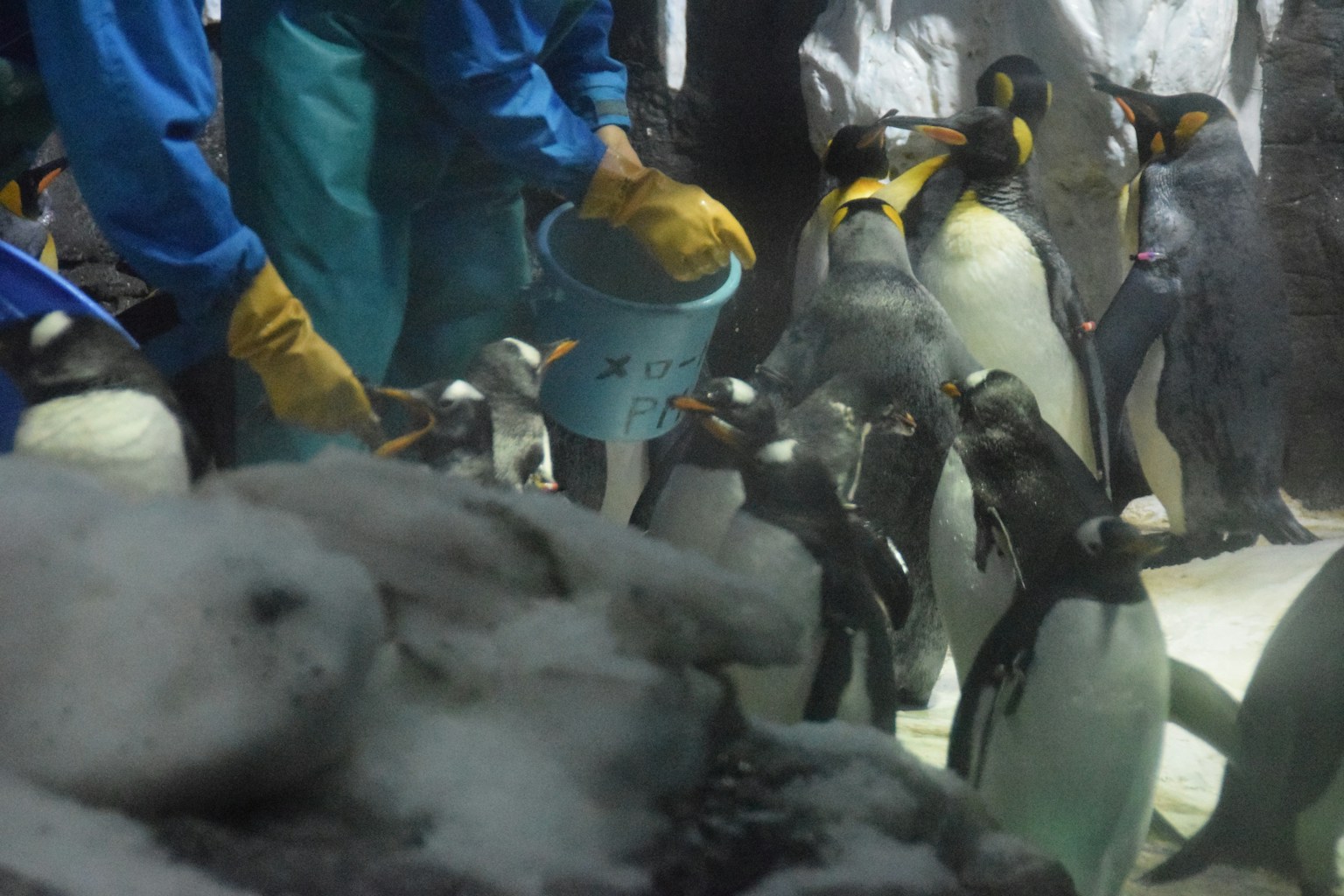
The indoor section of the aquarium is dedicated almost entirely to penguins.
The nine species are King, Gentoo, Chinstrap, Northern Rockhopper and Southern Rockhopper in the sub-Antarctic zone; Humboldt, Magellanic and African in the temperate zone; and the Little (Fairy) penguin — the smallest in the world at about 1 kg — in its own enclosure. There are no emperor penguins here, whatever you may have read elsewhere.
The tanks are large and well-maintained — the sub-Antarctic penguin pool is 4 m deep and holds 200 tonnes of water, among the biggest of its kind in Japan. Crucially for small children, the viewing windows sit at a low height — your toddler can press their face right up to the glass and watch penguins swimming directly toward them. The reactions are priceless.
The exhibits are laid out in a loop so it is almost impossible to get lost. You can comfortably see everything in about 45 minutes if you are moving at a toddler’s pace.
There are also touch pools inside where children can interact with starfish and other marine creatures under supervision — a huge hit with our five-year-old, and our toddler gamely reached in before we could stop her.
Why It Works Better Than Big Aquariums for Toddlers
We have done the big aquariums — Osaka, Fukuoka, even Okinawa — and while they are spectacular, they are genuinely exhausting with a toddler.
The Nagasaki Penguin Aquarium works so well for small children precisely because of its scale. There is no sensory overload. The crowd size stays manageable.
You can do a full loop, go outside for the parade, and be done before anyone has a meltdown. It is the rare attraction that actually matches a two-year-old’s attention span rather than fighting against it.
Fureai Penguin Beach: Don’t Miss It
The undisputed highlight of any visit is Fureai Penguin Beach, on the shoreline outside the main building.
Humboldt penguins are let out onto a natural beach, where they swim in the open sea and loaf about on the sand entirely as they please. The aquarium bills it as a world first, and it does feel completely different from watching birds in a tank. Feeding time and a paid feeding experience run alongside it.
The catch is that it is only held on weekends and public holidays, and it is suspended outright during the birds’ moult and whenever avian influenza is circulating in Japan. Individual days also get cancelled for weather.
Beach Schedule
Times shift with the season and the birds, so the aquarium publishes the day’s slots on its own event calendar rather than fixing them in advance. Look the date up on the official site before you commit to a plan, and check the noticeboard again when you arrive.
We recommend turning up at least 10 minutes early to secure a good spot. It gets surprisingly popular even on quiet days, and you want your child at the front.
If the beach is not running, the other outdoor draw for families is the kayaking — 730 yen an hour for a single and 1,090 yen for a tandem, weekends and public holidays from late April to late September. Children aged 4 and up can ride in a tandem with an adult, and an instructor comes with you.
The site also has the Penguin Plaza and a lawn area where children can burn off energy and where you are allowed to eat what you have brought.
Best Time to Visit
The aquarium is open every day of the year, but we think the sweet spot is spring (March to May) or autumn (October to November).
Summer school holidays bring larger crowds and the heat can make the outdoor areas uncomfortable for small children.
Winter is quieter, but the beach area feels bleak on cold days, and avian influenza alerts — which are most common over winter — can take the outdoor beach event off the schedule altogether.
Weekday mornings are almost always quieter than weekends. If you can arrive when the gates open at 9:00 am, you will have the indoor penguin tanks largely to yourselves for the first hour, and your child can take their time at each exhibit without being jostled.
Nearby Lunch Options
Plan lunch before you arrive: there is a kiosk and a penguin gift shop on the first floor, but eating inside the building is not allowed. Food and drink you bring yourselves can be eaten outdoors at the Penguin Plaza or the lawn area, which is the practical option with a hungry toddler.
Re-entry on the same day is permitted as many times as you like — just show your ticket at reception — so stepping outside to eat and coming back in is easy.
For a more substantial lunch, your best options are a 10-to-15-minute drive back toward central Nagasaki.
The city is famous for its champon (a rich noodle dish with seafood and vegetables) and sara udon, both of which are served at countless local restaurants.
These dishes are genuinely child-friendly — mild, filling, and easy for small hands to eat with a spoon or fork when chopsticks feel too ambitious.
If you are combining the aquarium with a broader day in Nagasaki, our Ultimate Family-Friendly Guide to Nagasaki with Kids has restaurant recommendations and itinerary ideas to help you fill out the rest of your day.
Combining with Other Nagasaki Attractions
The Penguin Aquarium pairs beautifully with a half-day in central Nagasaki.
If your children are animal lovers, consider adding a visit to Nagasaki Bio Park: Is the Capybara Zone Safe for Small Kids? — it is a very different kind of animal experience and the two attractions complement each other well over a two-day trip.
👉 Staying overnight to fit both parks in without rushing? Check family-friendly Nagasaki hotels on Agoda — filter for twin/triple rooms within walking distance of the tram lines for the easiest morning starts.
If you are using public transport for your Nagasaki day, the city’s tram network is genuinely fun for children, and it covers most of the main sightseeing areas.
We have a full rundown of routes and practical tips in our guide to Riding the Nagasaki Trams with a Stroller: Routes & Tips.
Planning a bigger Kyushu trip around this visit? Start with our Kyushu with Kids: The Complete Family Travel Guide (2026), which covers the whole island with family-specific advice by region.
Our Honest Verdict
The Nagasaki Penguin Aquarium is not trying to be Osaka Kaiyukan.
It knows what it is — a brilliant, affordable, focused experience — and it delivers on that completely.
For families with children under five especially, the small scale is a feature, not a limitation.
You see the animals up close, you get to be part of the parade, and you are done and fed before anyone has a tantrum. We would go back without hesitation.
Frequently Asked Questions
What age is the Nagasaki Penguin Aquarium suitable for?
It is suitable for all ages, but it is particularly well-suited to children between one and six years old.
The low viewing windows, accessible exhibits, and short walking distances make it ideal for toddlers. Older children (primary school age) will also enjoy the touch pool, the virtual theatre and the beach event, though teenagers may find the experience a little brief.
Do I need to book tickets in advance?
No advance booking is required at the aquarium gate itself. Tickets are sold on the day and even on busy weekends the queue moves quickly.
Cards, e-money and QR payments are accepted at the window and the ticket machines. If you are visiting during Japanese school holidays (Golden Week, Obon, or the New Year period), arriving early helps you secure the best spots at the beach.
Bundled Nagasaki day passes on Klook can also be worth a look if you plan to combine the aquarium with Huis Ten Bosch, Glover Garden, or Mount Inasa in the same trip.
Is Fureai Penguin Beach guaranteed every visit?
No — and this is the single most important thing to know before you plan around it. It runs on weekends and public holidays only, and it is suspended entirely during the penguins’ moult and during avian influenza alerts, which have taken it off the schedule for months at a time in recent years.
Individual days are also cancelled for weather. Check the official site’s event calendar for your date, and treat the beach as a bonus rather than the reason for the trip.
How long should I budget for a visit?
The aquarium’s own guidance is about one hour for the indoor exhibits. Most families with young children end up spending between 1.5 and 2.5 hours once you add the touch pool and time outside.
If you are visiting on a weekend for the beach event, or walking the biotope trail between car park 1 and the entrance, allow three hours. It is a comfortable half-day outing rather than a full-day commitment.
Not sure where to begin? This free guide helps you pick the right Kyushu trip for your family — from a Fukuoka family who actually lives here.
- ✅A simple “which trip suits us?” chooser — by days, ages & interests
- ✅Snapshots of all 7 prefectures — what’s actually worth it with kids
- ✅Instant PDF download — name your price (free), no spam
Onsen, rail, or a full itinerary? It points you to the right deep-dive guide.