
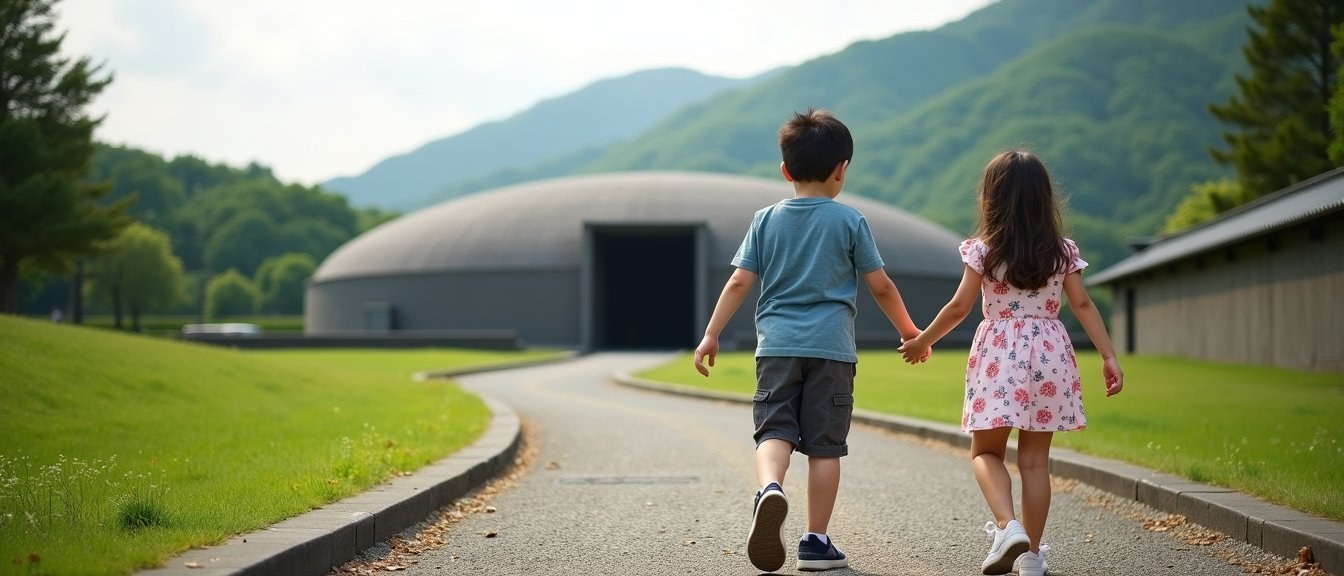
The Nagasaki Atomic Bomb Museum is one of the most important places you can visit in Japan — and one of the most difficult to plan around with children. Parents usually arrive with the same quiet question: should we really bring the kids in there? This is the guide we wish we had when we first visited as a family based in Fukuoka. No sugar-coating, no lectures — just a straight, age-by-age assessment, a route that works with a stroller, and honest advice on when to swap the museum for a gentler alternative.
Is It Appropriate for Kids? An Age-by-Age Honest Assessment
There is no single right answer, so we break it down by the age of the child rather than the age of the parent’s comfort level. Use this as a starting point, then trust what you know about your own kid.
Ages 0–5: Skip the main museum
For babies, toddlers, and preschoolers, the main exhibition is not appropriate. The photos of burn victims, the distorted bento boxes, the shadows on stone — these images will not “wash over” a 3-year-old the way parents sometimes hope. Younger kids pick up on the hushed tone, the dim lighting, and the crying strangers around them, even if they can’t read a single panel. Visit the Peace Park and Hypocenter Park outside, which are stroller-friendly and quietly powerful, and save the museum itself for a later trip. If you’re traveling with a toddler, our guide to riding Nagasaki’s trams with a stroller will make the approach much easier.
Ages 6–9: Possible, but plan carefully
This is the hardest age to judge. Some 7-year-olds handle the museum thoughtfully; others have nightmares for a week. If your child is sensitive to graphic imagery, anxious about death, or newly aware of war through school or media, it’s usually too early. If they’ve asked questions about World War II, understand the concept of “a long time ago,” and can follow a 45-minute museum at their own pace, you can try it — but pre-brief them (see the script below), skip the most graphic rooms, and agree on an exit signal before you enter.
Ages 10+: Genuinely educational
From around 10, most kids can engage with the museum as intended. They can read the English panels, follow the chronology, and process the harder images without being overwhelmed. Our own 10-year-old was quiet for most of the visit and had questions for days afterwards — exactly the reaction the museum is designed to create. Teenagers often find it one of the most meaningful stops of an entire Kyushu trip.
What You’ll See Inside: The Emotional Intensity Map
The permanent exhibition is laid out in four lettered corners: A — 9 August 1945 (pre-war Nagasaki, ending with the clock stopped at 11:02), B — Damage caused by the atomic bomb, C — Towards a world without nuclear weapons, and D — video room and Q&A corner. Intensity is not evenly distributed. Here’s what to expect, corner by corner, on a 1–5 “heaviness” scale.
Before you go, check the museum’s notices. The permanent exhibition is being renewed in stages between September 2026 and March 2027, and parts are closed while the work is done — the special exhibition room for the whole period, and sections of corners A, B, C and D on a rolling schedule. The rest stays open, but the schedule shifts with the building work, so confirm on the official museum site before travelling.
- Entrance spiral, then corner A (2/5): mostly gentle — old photos, street scenes, maps of the pre-war city. It closes, though, with the clock stopped at 11:02, so the first emotional hit comes earlier than parents expect.
- Corner B, opening rooms (3/5): the flattened city, the Urakami Cathedral section (the museum’s side wall is a full-size re-creation; the surviving original fragment stands outside in Hypocenter Park), the terrain model with light showing the fireball and blast, and the Fat Man replica. Kids often find this fascinating rather than upsetting.
- Corner B, heat-ray and blast rooms (5/5): this is the hardest stretch — photographs of burn injuries and clinical descriptions of what the heat ray did to skin. This is the part to skip or walk through quickly with under-10s.
- Corner B, radiation, relief work and Dr Nagai (3/5): medical and human, but far less graphic.
- Corner C — a world without nuclear weapons (2/5): maps, treaty information, age-appropriate for older kids.
- Corner D — video room and Q&A (2/5): documentary screenings and a search system; a good place to sit down.
The good news: the hardest rooms are relatively compact, and you can loop around them without losing the narrative. One thing to brace for on the way out: the photograph The Boy Standing by the Crematory hangs at the B1 exit of the route (photography of it is prohibited, as it is of The Hiroshima Panels by the B2 ticket machines). Knowing this in advance lets you guide the visit instead of being ambushed by it.
How to Prepare Your Child Before the Visit
Don’t walk in cold. A five-minute conversation the night before makes a huge difference. Here’s the script we actually used with our 10-year-old, which you can adapt.
English version: “Tomorrow we’re going to a museum about something sad that happened a long time ago — in 1945, near the end of a big war. A very powerful bomb was dropped on this city, and a lot of people died or got very hurt. The museum shows this so people never forget and never let it happen again. Some photos will be hard to look at. If you feel sad or want to leave, just squeeze my hand and we’ll step outside. There’s no test, and you don’t have to look at anything you don’t want to.”
A few rules that helped us:
- Give them an exit signal. A hand squeeze, a word, anything. Knowing they can leave makes them more willing to stay.
- Don’t promise “it won’t be scary.” It will be. Promise instead that you’ll be next to them the whole time.
- Skip the human damage room if in doubt. Tell them in advance: “I’m going to take us around this next room — I looked at it already.”
- Plan something gentle for afterwards. Not a theme park, but something calm — a park, a snack, a harbor view.
Suggested Route: Museum → Peace Park → Hypocenter (Stroller-Friendly)
Most first-timers do this circuit in the wrong order and end up exhausted. Here’s the route that works best for families, especially with a stroller.
- Start at the Hypocenter Park (Heiwa-koen / Peace Park tram stop, line 1 or 3 — the stop was called Matsuyama-machi until it was renamed). A simple black stone marker shows where the bomb detonated 500 m above. It’s outdoors, quiet, stroller-flat, and a gentler emotional entry than the museum.
- Walk up to the Peace Park (5–7 minutes via the escalators next to the hypocenter — yes, there are escalators, a huge help with strollers). The Peace Statue and Fountain of Peace are here.
- Then enter the Atomic Bomb Museum, about 5 minutes’ walk downhill. By now the kids have had fresh air and context.
- Finish at the National Peace Memorial Hall (next door, free, see next section) — the quietest and most contemplative space of the three. If you can stretch the day to 16:30 or later, the ~70,000 fibre-optic lights in its outdoor water basin are switched on between 16:30 and 18:30.
Total walking distance is under 1 km, almost entirely paved, with ramps and elevators at the museum. Strollers fit into all elevators. The only stairs-only shortcut is between Peace Park and the hypocenter if you skip the escalator route — easy to avoid.
When to Skip the Museum: The National Peace Memorial Hall as a Lighter Alternative
If your child is under 10 or particularly sensitive, you can still make the trip meaningful without the main museum. The National Peace Memorial Hall for the Atomic Bomb Victims, right next to the museum, is free, quiet, and contains almost no graphic imagery. Above ground you walk anticlockwise around a shallow water basin; after dark it carries about 70,000 fibre-optic lights, one for each person estimated to have died by the end of December 1945 — but they are only lit from 16:30 to 18:30, so a morning visit will not see them. Downstairs, a 10-minute route on B1 leads to the Remembrance Hall on B2, where the registers of the dead are kept: 208 volumes holding 204,708 names as of 9 August 2026. Admission is free, hours match the museum’s, and it closes only 29–31 December (official site).
For younger kids, we recommend:
- Peace Park (the Peace Statue and the international peace monuments)
- Hypocenter Park (the black stone marker and the preserved cathedral wall)
- National Peace Memorial Hall (as above — 15–20 minutes is plenty)
Combined, this is a 60–90 minute visit that is deeply meaningful, stroller-friendly, and won’t traumatize a 6-year-old. You can always return to the museum itself in a few years.
Practical Info: Tickets, Hours, Toilets, Nursing Rooms
- Address: 7-8 Hiranomachi, Nagasaki. Nearest tram stop: Genbaku-Shiryokan (Atomic Bomb Museum) on line 1 or 3, 5 minutes on foot. The old name Hamaguchi-machi now belongs only to the bus stop, which is also 5 minutes away.
- Hours: 8:30–17:30 (last entry 17:00) in April and September–March; 8:30–18:30 (last entry 18:00) May–August; 8:30–20:00 (last entry 19:30) on 7–9 August only. Closed 29–31 December.
- Tickets: ¥200 flat for anyone 15 and over. Everyone of high-school age and under is free — since 1 April 2026 the museum has scrapped group rates and made all under-18s free (show a student ID at the permanent-exhibition desk). Ticket machines are on B2, and there is a web ticket that skips the queue. The Peace Park, Hypocenter Park and National Peace Memorial Hall are free anyway.
- Audio guide: ¥160 per unit, in 12 languages including English, hired from the ticket desk on B2 (no reservations). There is no dedicated kids’ audio guide — one of the museum’s gaps — but QR codes beside the main exhibits pull up commentary in 11 languages on your own phone.
- Toilets: clean, well signed, with Western-style stalls. Baby changing tables in both men’s and women’s restrooms near the entrance.
- Nursing room: on the 1F (ground) floor — the rest room doubles as the nursing room, next to the library and children’s book corner. Note that the entrance lobby, shop and cafe are down on B1 and the exhibition is on B2, so it is a lift ride back up.
- Stroller policy: strollers are welcome throughout. Elevators connect all floors.
- Lockers: coin lockers (¥100, returned to you) behind the information desk and outside the museum hall. Lockers big enough for a suitcase cost ¥200 and are not refunded.
- Food: there is a proper cafe — Peace Cafe on B1, next to the museum shop — plus a vending corner on 1F. Important with kids: eating and drinking is banned everywhere else in the building, and the only two places you may even have a drink are the Ikoi-no-Hiroba lounge on B1 and that 1F vending corner. Plan lunch outside (see recovery section).
Day Trip from Fukuoka: Realistic Timing & Transport
Nagasaki is a very doable day trip from Fukuoka since the Nishi-Kyushu Shinkansen opened. But with kids, “doable” and “enjoyable” are different things. Here’s the honest timing.
- Hakata → Nagasaki: about 1 hr 20 min via Limited Express Relay Kamome + Nishi-Kyushu Shinkansen (transfer at Takeo-Onsen, cross-platform, very easy with a stroller).
- Nagasaki Station → Atomic Bomb Museum: 15–20 min by tram (line 1 or 3 northbound to the Genbaku-Shiryokan stop).
- Minimum realistic museum + Peace Park visit: 2 hours.
- Lunch + recovery stop: 1.5–2 hours.
- Total door-to-door day: 10–11 hours. Long, but manageable if you leave Hakata by 8:30 a.m.
If this sounds too much for your family, consider staying one night in Nagasaki and spreading the visit across two calmer days. For a full route including Saga, our 5-day Kyushu itinerary with Fukuoka, Saga and Nagasaki shows exactly how to fold Nagasaki into a longer family trip without burning out.
After the Visit: Recovery Spots for Kids in Nagasaki
This is the part almost every guide skips. After the museum, your kids (and you) will need a mental reset. Don’t head straight back to the station. Build in one of these nearby spots instead — each works as a contrast, not as a distraction.
Dejima — gentle history with something to do
About 15 minutes back toward the harbor by tram, Dejima is the reconstructed Dutch trading post where kids can walk through old warehouses, try on kimono, and see a scale model of the whole island. It’s hands-on, bright, and a reminder that Nagasaki has had an international, optimistic history for 400 years — not just one terrible morning. See our full Dejima with kids guide for the family-friendly route through the site.
Chinatown and harbor walk
Nagasaki’s Shinchi Chinatown is five minutes from Dejima and perfect for a late lunch of champon or steamed buns. Kids love the dragons and the lantern-decorated streets, and if your visit lines up with the festival, the Nagasaki Lantern Festival turns the whole area into a family-friendly outdoor event — it runs for about a fortnight from Chinese New Year, so the dates move every year and are worth checking on the official site before you plan around them.
Glover Garden — views and a hilltop breeze
A few tram stops further south, up the Minamiyamate hillside above the same waterfront (tram line 5 to Oura-Tenshudo), the hilltop walk through Glover Garden is ideal for stretching legs after a heavy morning. Outdoor escalators handle the steepest sections, and the views over the port are a quiet kind of beautiful. Entry is ¥1,300 for adults and ¥650 for school-age children, open from 8:00.
Penguin Aquarium or Mount Inasa for the full reset
If you have small kids who just need something fun, the Nagasaki Penguin Aquarium is a straight run east on the Kenei bus bound for Aba or Kasuga-shako-mae from the Nagasaki Station transport plaza, and an instant mood-lifter (¥800 adults, ¥400 school-age, under-6s free). For families staying overnight, ending the day with the night view from Mount Inasa is an almost cinematic way to close a heavy day — the city you learned about in the morning is now lit up and alive beneath you.
FAQ
What is the minimum age for the Atomic Bomb Museum?
There is no official minimum age — children of all ages are allowed. But based on the content, we personally don’t recommend the main exhibition for under 6, and suggest parents make a case-by-case call for ages 6–9. From around 10, most kids can handle it with preparation.
How long should we spend there?
Plan 60–90 minutes for the museum itself, plus 30–45 minutes for the Peace Park and Hypocenter, and 15–20 minutes for the National Peace Memorial Hall. A thorough, unhurried family visit is about 2.5 hours.
What if my child starts crying or wants to leave?
Leave. There is no “wasted” ticket here — the Peace Park and Memorial Hall outside are free and equally meaningful. Step outside, find a bench, and let them decompress. You can always return solo while your partner watches the kids.
Is there a kid-friendly audio guide or activity sheet?
Not in the sense of a scavenger hunt. The English audio guide is written for adults and there is no children’s worksheet in English. What does exist is worth using: the museum publishes a free leaflet you can download in 13 languages before you go, plus a Japanese learning handbook it will post to you on request; volunteer Peace Guides give free commentary in the museum and the Memorial Hall daily from 10:00 to 16:00; and the 1F library has a children’s book corner (9:00–17:00, closed Mondays and 29 December–3 January).
Is the museum stroller-accessible?
Yes, completely. Elevators connect every floor, aisles are wide, and strollers are welcome throughout. The Peace Park is also paved and flat, with escalators linking the main levels.
Should we do this as a day trip from Fukuoka or stay overnight?
If your kids are 10+ and used to long travel days, a day trip works. For younger families, we strongly recommend one night in Nagasaki — it lets you split the heavy museum morning from a lighter second day of Dejima, Glover Garden, or the Penguin Aquarium without anyone melting down on the train home.
More Nagasaki Family Guides
- Dejima Nagasaki with Kids: Hands-On History at the Dutch Trading Post
- Glover Garden Nagasaki with Kids: Tips for the Hilltop Walk
- Mount Inasa Nagasaki Night View with Kids: Timing, Ropeway & Tips
- Riding the Nagasaki Trams with a Stroller: Routes & Tips
- Nagasaki Penguin Aquarium with Kids: A Toddler-Friendly Day Out
Visiting the Atomic Bomb Museum with children is never a casual stop on a sightseeing list. Done right — with honest preparation, a gentle route, and a recovery plan — it can be one of the most lasting things you do together in Japan. Done wrong, it just scares them. Pick the age, pick the route, and leave room for both silence and snacks.
 Nagasaki Harbor Stays
 Nagasaki: History & Theme Parks
Not sure where to begin? This free guide helps you pick the right Kyushu trip for your family — from a Fukuoka family who actually lives here.
- ✅A simple “which trip suits us?” chooser — by days, ages & interests
- ✅Snapshots of all 7 prefectures — what’s actually worth it with kids
- ✅Instant PDF download — name your price (free), no spam
Onsen, rail, or a full itinerary? It points you to the right deep-dive guide.