
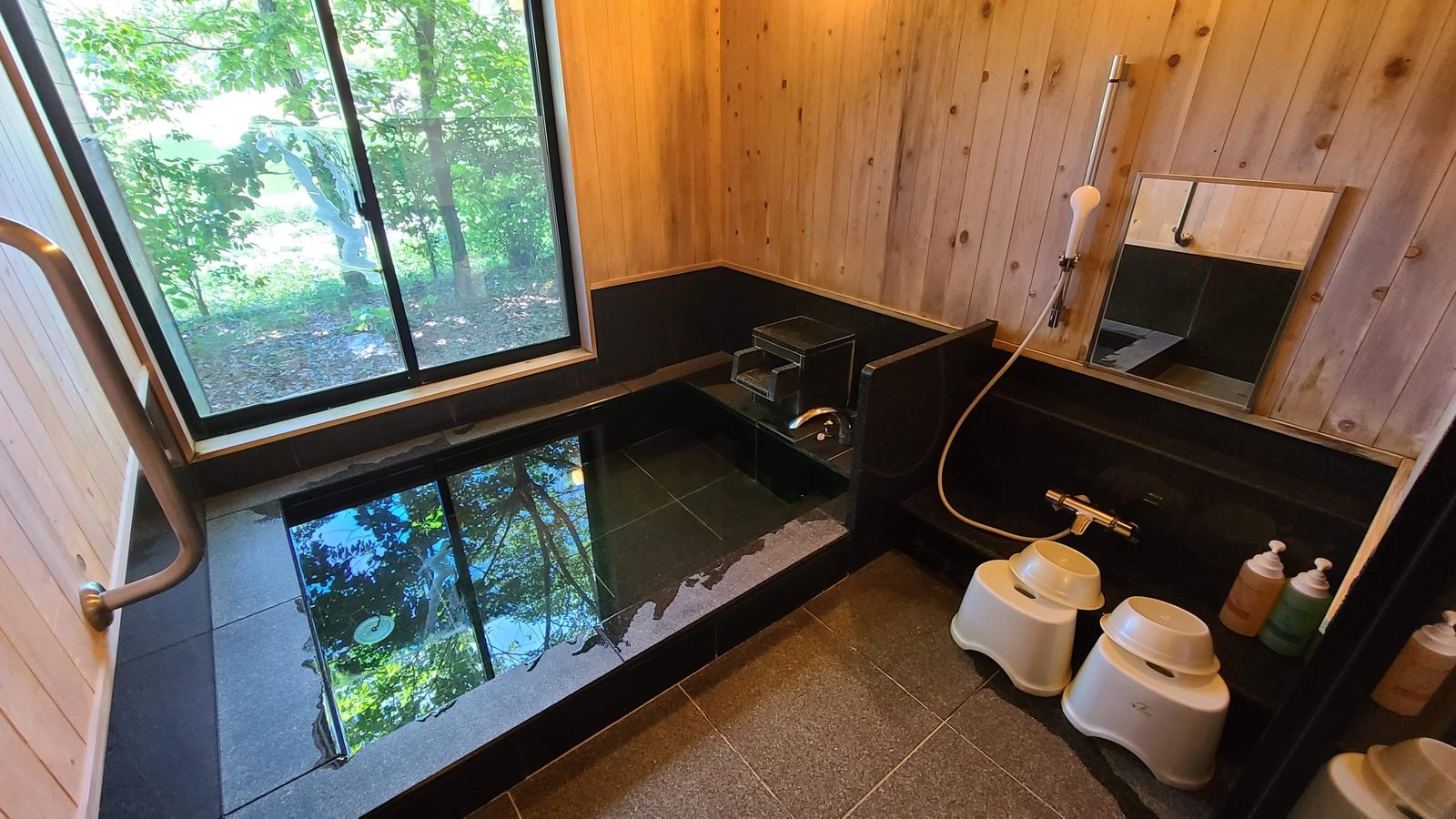
The first time you lower a two-year-old towards a Japanese hot spring, you learn something the guidebooks skip: most onsen are run at 41–43°C, and a toddler’s hand will come back out of that water before their foot goes in. Japan’s consumer-safety agency puts a baby’s bath at 38–40°C, which is several degrees below almost every public bath in the country. The good news is that Kyushu, with more hot-spring sources than anywhere else in Japan, also has the answers: a handful of springs that come out of the ground lukewarm, and hundreds of private family baths (kazoku-buro) that are filled fresh for each group and can be run cooler if you ask. This guide explains what temperature is safe, how to find a bath your toddler can actually sit in, and which specific places we would send a family with children under four.
Is Onsen Water Too Hot for Toddlers? (Quick Answer)
Usually, yes: standard onsen run at 41–43°C while Japan’s Consumer Affairs Agency recommends 38–40°C for babies. In Kyushu, pick one of three fixes. Go to a naturally lukewarm spring such as Lamune Onsen (Nagayu Onsen) in Oita, whose family bath has a 32°C tub beside the 42°C one. Or book a refilled-per-group private bath (Beppu’s Hyotan Onsen (self-service sand bath) is the model) and ask for it cooler with “nurume ni dekimasu ka?”. Or choose a ryokan room with its own tub and a cold tap. Keep first soaks to 3–10 minutes.
How Hot Is a Japanese Onsen, and What Is Safe for a Small Child?
The numbers matter here, so here are the ones that come from official sources rather than forum folklore.
- Typical bath temperature: the Kurokawa Onsen ryokan association’s own FAQ states its baths run at about 40–43°C and that this is hot for infants, recommending short soaks only. That range is representative of Kyushu generally.
- Baby-safe temperature: the Consumer Affairs Agency’s child-safety guidance for baby baths gives 38–40°C, “slightly cooler than an adult’s bath”, and tells parents to measure with a thermometer rather than a hand. It also records burn cases where hot water was topped up while the baby was still in the tub, so add water only with the child out.
- How long: the Ministry of the Environment’s onsen guide, supervised by the Japanese Society of Balneology, and the Japan Spa Association both advise 3–10 minutes per soak until you are used to the water, and warn against leaving children to bathe alone.
- Which springs to avoid: the same environment-ministry guide flags acidic and sulphur springs as harsh on sensitive skin and says to rinse them off with plain water; Beppu’s Myoban and parts of Kirishima are sulphur country, so save those for the adults.
The practical rule we use with a toddler: aim for water under 40°C, do “kakeyu” (pour a few scoops over legs and arms first), sit them in for a few minutes, out, drink, and repeat if they want to. For the etiquette side of taking children into a bath at all, our onsen etiquette with kids guide covers the rest.
Three Ways to Get a Cooler Bath in Kyushu
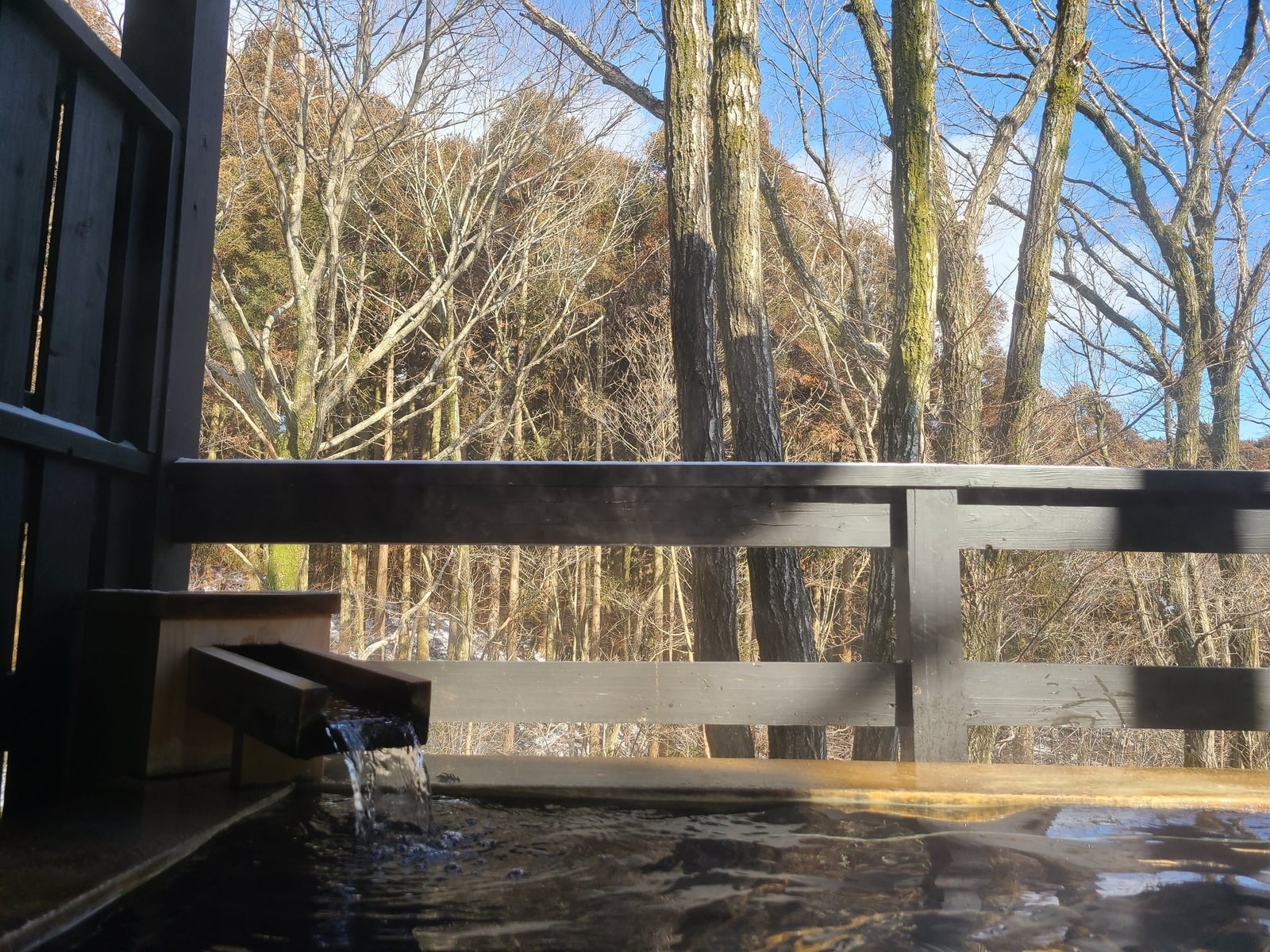
1. Naturally lukewarm springs (nuru-yu)
Some sources simply come out of the ground at 32–39°C. These are the surest option because nothing depends on staff or plumbing; the catch is that most of them are shared public baths rather than private rooms, so they suit a confident toddler more than a newborn. The list below is limited to springs whose operators publish the temperature.
2. Refilled-per-group private baths (kazoku-buro on a coin timer)
Kyushu’s day-use family baths, especially around Beppu, Yamaga’s Hirayama Onsen and the Fukuoka suburbs, are typically “irekae-sei”: the tub is drained and refilled for every group, often on a coin timer. Because the water is being run fresh for you, this is the format where a request for a cooler fill is most likely to be honoured. None of the operators we checked promise a cold tap in writing, so ask at reception rather than assuming. Booking rules, prices and how to reserve these rooms are in our private onsen booking guide.
3. A ryokan room with its own bath
An in-room tub almost always has ordinary taps, so you control the temperature completely and nobody is watching you dilute a famous spring. This is the expensive option, but with a baby it is also the calmest one. Family-oriented ryokan with in-room or private baths are listed by area in our ryokan with private onsen near Fukuoka and Saga family ryokan guides.
Naturally Lukewarm Springs in Kyushu (Published Temperatures)
| Spring | Water temperature (operator’s figure) | Private option? | Toddler notes |
|---|---|---|---|
| Lamune Onsen (Nagayu Onsen), Nagayu, Taketa (Oita) | 32°C outdoor carbonated bath; 42°C indoor bath; the family bath has both a 42°C and a 32°C tub | Yes: 3 family-bath rooms, Public baths ¥800 adult / ¥400 elementary / ¥200 preschool; family bath ¥3,000 per hour, walk-in only (numbered tickets from 7:30) | The best single answer in Kyushu. Children still in nappies use the outdoor bath in a baby bath the onsen lends; shower and toiletries provided in the family rooms |
| Shichirida Onsen Shitan-yu, Kuju, Taketa (Oita) | 36.5–37°C at source | No: small men’s and women’s baths, key collected from the Konoha no Yu bathhouse with a ¥1,000 deposit | Fizzing carbonated water kids love; the operator says it is comfortable from late April to about October and chilly in winter. Ventilated because of the gas; rinse before entering |
| Kabeyu Onsen Fukumotoya, Kokonoe (Oita) | 39°C simple spring, 24-hour cave bath | Two private baths at the inn; day bathing reception 10:00–16:00 | The cave bath is mixed-gender, which is fine with small children and awkward with older ones. Confirm the private baths are open to day visitors when you call |
| Kawazoko Onsen Keisenso, Kokonoe (Oita) | Three adjoining tubs at three temperatures (the inn does not publish the figures; source is 82°C before cooling) | Yes: 60-minute private bath ¥3,000 for two adults and one child | Day bathing 10:00–17:00, ¥1,000 adult / ¥600 child; men’s and women’s sides swap by day and time |
Nagayu and Kuju sit in the highlands south of the Yamanami Highway, about 25–30 minutes by car from Bungo-Taketa Station, so they fit naturally into an Aso-to-Beppu drive; see the Yamanami Highway with kids guide for the route. If you stay at Lamune’s sister inn, Daimaru Ryokan, the onsen is free for guests.
Refilled Family Baths You Can Ask to Run Cooler
Beppu: coin-timer family baths with baby gear
 Beppu Onsen Resorts
Hyotan Onsen (self-service sand bath) in Kannawa is the reference point. Its 14 family-bath rooms are refilled on a coin timer for every group, they must be booked by phone from a week ahead, and prices start at ¥2,400 for 60 minutes for up to three adults, with children aged 4–12 at ¥300 extra and under-3s free. Two things make it unusually toddler-ready: the operator’s FAQ says the baths are set “slightly on the cool side” with staff checking and adjusting by hand rather than by machine, and the women’s public bath has baby bath chairs, a changing bed and a nursing space. It cools its 100°C source through bamboo towers rather than by diluting it, so do not expect a cold tap in the room; ask for a cooler fill when you book. Two more Beppu options, Sakurayu (20 refilled rooms, ¥2,000–3,000 for 60 minutes, bookable outside holidays) and Okata no Yu (8 refilled indoor rooms, walk-in only, and an FAQ that says children of any age are welcome), are covered with the rest of the city’s private baths in our kashikiri onsen in Beppu guide.
Hirayama Onsen (Yamaga, Kumamoto): the family-bath capital
Hirayama is a village of family-bath halls rather than public baths. Yudokoro Fugetsu (Hirayama Onsen) has 17 private rooms, all on 60-minute slots, states that it refills the water for every group and has no communal bath at all; rooms are ¥2,000–3,200 with ¥500 off on weekday afternoons. Yunokawa nearby has 10 rooms from ¥1,800 with no limit on the number of people. None publish an age rule, and the water here is famously soft, which suits young skin. Hirayama is 30 minutes north of Kumamoto city and pairs well with a night in Yamaga Onsen.
Within an hour of Fukuoka
Two day-use options near the city are explicit about babies. Nansuikaku Day-Use Family Baths Hidamari (Wakita Onsen) at Wakita Onsen has six rooms refilled for every group so “you always get the first bath”, walk-in only, 1 room ¥3,300 / 60 min on weekdays, ¥3,500 / 50 min on weekends and holidays; +¥1,200 per 30 min extension (weekdays only). Tenpai no Sato Family Baths (Chikushino) in Chikushino has six reservable rooms (Family bath 60 min ¥3,000 (small) / ¥3,400 (medium) / ¥3,800 (large), up to 5 adults; +¥1,000 on weekends and holidays; reservations up to 1 month ahead) with baby shampoo and body wash in every room, but note its rule: children still in nappies cannot go into the tub and are given a baby bath instead. Tenpai no Sato also points out a Fukuoka Prefecture rule that children aged 7 and over may not use mixed-gender baths, which is one more reason a private room beats the public bath once your eldest hits primary school.
Yufuin and Kurokawa
In Yufuin, the hillside Sanso Musouen opens three family baths to day visitors on a first-come basis between 10:00 and 14:00 (adults ¥1,000, ages 5–12 ¥700, ages 0–4 free), which is a rare free-for-infants policy at a well-known ryokan. In Kurokawa, be aware that the village’s nyuto tegata bath pass is not valid for family baths, that day-use family baths are generally not reservable, and that overnight guests get priority after 15:00. Ikoi Ryokan (Kurokawa Onsen) sells 40-minute private baths at ¥1,500 per adult and ¥900 for ages 3–12 between 10:00 and 15:00. For the wider picture on both towns, including the steep lanes that make Kurokawa hard with a buggy, see Yufuin and Kurokawa with a stroller and the Kurokawa with kids guide.
Nappies, Ages and the Rules That Differ by Bath
Whether a child still in nappies can go in the water is decided bath by bath, and the rules run in both directions, so check before you build a day around one.
| Bath | Children in nappies | Free age | Other rule |
|---|---|---|---|
| Lamune Onsen (Nagayu) | Outdoor bath only in a baby bath, lent by the onsen | Preschoolers pay ¥200 in the public baths | Family bath walk-in only; numbered tickets from 7:30 before opening |
| Hyotan Onsen (Beppu) | Not stated; baby bath chairs and changing bed in the women’s bath | 3 and under free | Family baths must be phoned a week ahead |
| Tenpai no Sato (Chikushino) | Not in the tub; baby bath provided in the room | Preschool amenity gift | Ages 7+ may not use mixed baths (prefectural rule) |
| Kurokawa ryokan (association FAQ) | Allowed, short soaks advised at 40–43°C | Under 3 free | Tegata pass not valid for family baths |
| Sanso Musouen (Yufuin) | Not stated | Ages 0–4 free | Day-use family baths first come, 10:00–14:00 |
| Yugawachi Onsen Kajikaso (Kagoshima), 38–39°C | Not permitted | — | Asks visitors under 12 to refrain; listed here only so you do not drive to it |
The Japanese You Need at Reception
- Nurume ni dekimasu ka? (ぬるめにできますか?) Can you make it a bit cooler?
- Mizu de umete mo ii desu ka? (水でうめてもいいですか?) Is it okay to add cold water?
- Kazoku-buro / kashikiri-buro (家族風呂 / 貸切風呂) family bath / private bath. In Kyushu the first word is the everyday one.
- Irekae-sei (入れ替え制) refilled for each group. If you see this on a sign, the water is being run fresh for you.
- Kasui-nashi / gensen kakenagashi (加水なし / 源泉かけ流し) undiluted, free-flowing source. A point of pride, and a hint that the operator may be reluctant to dilute it.
- Omutsu no ko wa haitte mo ii desu ka? (おむつの子は入ってもいいですか?) Can a child in nappies go in?
A 15-Minute Toddler Onsen Routine
- Check the temperature. A cheap bath thermometer weighs nothing and settles arguments; under 40°C is the target.
- Kakeyu: pour water over feet, then legs, then arms, so the child feels it before committing.
- Sit them on your knee in the shallowest part for three to five minutes. Chest-deep, never chin-deep.
- Out, towel, water to drink. If they want back in, one more short round.
- Skip acidic or sulphur springs for babies and rinse older kids with plain water afterwards.
- Never top up hot water while a child is in the tub, and never leave a child in a bath alone, even a private one.
Which Kyushu onsen towns suit which ages, and how to plan a whole trip around them, is the subject of our complete guide to onsen in Kyushu with kids.
Frequently Asked Questions
What temperature is safe for a toddler in an onsen?
Japan’s Consumer Affairs Agency recommends 38–40°C for babies, slightly cooler than an adult bath, measured with a thermometer. Most onsen run at 41–43°C, so look for a naturally lukewarm spring or a private bath you can have filled cooler, and limit soaks to 3–10 minutes.
Can you add cold water to an onsen bath?
In a refilled-per-group private bath it is often possible, but no Kyushu operator we checked promises a cold tap in writing, so ask at reception with “mizu de umete mo ii desu ka?”. In-room ryokan baths have ordinary taps. Never add hot water while a child is in the tub.
Which onsen in Kyushu is lukewarm enough for a baby?
Lamune Onsen in Nagayu, Oita, runs a 32°C outdoor carbonated bath and its family bath contains both a 32°C and a 42°C tub. Shichirida’s Shitan-yu (about 37°C) and Kabeyu’s cave bath (39°C) are also cool, but they are shared rather than private.
Can a child in nappies go into an onsen?
It depends on the bath. Lamune Onsen lends a baby bath for the outdoor pool, Tenpai no Sato near Fukuoka provides a baby bath in the family room but bans nappies in the tub, and the Kurokawa association allows infants with short soaks. Ask before you go.
How much does a private family bath cost in Kyushu?
Day-use family baths typically cost ¥2,000–3,800 for 50–60 minutes for the whole group, with children under 3 usually free. Examples: Hyotan Onsen in Beppu from ¥2,400, Fugetsu in Hirayama ¥2,000–3,200, Lamune Onsen ¥3,000, Ikoi Ryokan in Kurokawa ¥1,500 per adult for 40 minutes.
Do you need to reserve a family bath?
It varies. Hyotan Onsen and Tenpai no Sato are reservation-only (phone a week ahead, or up to a month ahead); Lamune Onsen, Nansuikaku’s Hidamari and most Kurokawa day-use baths are walk-in only. Kurokawa’s tegata pass does not cover family baths.
Is a private bath better than the public bath with kids?
For children under four, yes: you control the temperature, there is no etiquette pressure, and nappies are easier to manage. It also solves the rule in Fukuoka Prefecture that children aged 7 and over cannot use mixed baths, which otherwise splits a family by gender in the public bath.
How long should a toddler stay in an onsen?
Three to ten minutes per soak, per the Japan Spa Association and the environment ministry’s onsen guide, with a break for water in between. Keep the water chest-deep, pour water over limbs first, and never leave a child in the bath alone.
Onsen with kids is a maze of rules. This done-for-you playbook removes the guesswork — written by a Fukuoka family who soaks here year-round.
- ✓Family-bath & private (kashikiri) ryokan — baby-OK, tattoo-friendly, named picks
- ✓Babies & toddlers — water-temp tactics, cribs/baby-bath rentals, what to pack
- ✓Etiquette, made simple — exactly what to do so nobody stares
Instant PDF · written by locals · skip hours of forum-digging
Not sure where to begin? This free guide helps you pick the right Kyushu trip for your family — from a Fukuoka family who actually lives here.
- ✅A simple “which trip suits us?” chooser — by days, ages & interests
- ✅Snapshots of all 7 prefectures — what’s actually worth it with kids
- ✅Instant PDF download — name your price (free), no spam
Onsen, rail, or a full itinerary? It points you to the right deep-dive guide.